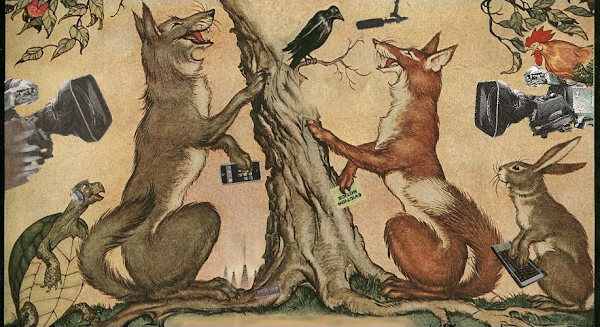


Once, there was a Raven who, having nothing better to do (since raven's are notoriously bad at sales and the health department frowns on having them work around food), spent her days stealing corn and cawing and then stealing more corn. The other birds of the forest looked at her and became concerned, knowing that she didn't have health insurance.
"Friend Raven!" the other birds shouted, as seen by the exclamation mark at the end of their dialogue. "We have decided to come together and form a health care collective that will allow us all to have access to affordable and quality health care. We would like you to join."
"What!" cawed the Raven, also in kind of a shout, "How dare you offend me with your socialist attitudes! Why would you think I would EVER want to be part of your anti-capitalist, leftist schemes! Why, I expect you would take my own beloved grandmother out to a field and kill her!"
The other birds, who were too kind to point out that Raven's grandmother had been dead for several years following a scarecrow induced heart attack, simply nodded their heads and went back to pecking the ground at random intervals in case there was food and picking fleas out from under their wings.
Later in the day, as Raven was stealing some corn, a farmer came out and shot at her. Now, the farmer, being nearsighted and a terrible shot anyway, didn't hit the crow, but, instead, sheared off the post that held up the farmer's scarecrow. The scarecrow tumbled forward, landing on Raven and crushing her hollow bird-bones in about eight-seven places. "Help!" cried the Raven, "I feel my bones have been broken in eight-seven places! Please, someone send a doctor!"
But, of course, Raven's insurance called "crushed by scarecrow" a pre-existing family-related illness and refused to pay anything toward it, despite the sky-high corn premiums Raven paid bimonthly. Because the insurance wouldn't pay, no doctor birds would touch her unless she paid in advance, and Raven, being a raven who had spent her days stealing corn and cawing and stealing more corn, had no money at all. (In fact, none of the birds had any money, since they were, after all, birds, and they were notoriously bad financial managers anyhow, but that we'll leave for another fable, such as "The Birds and the Sub-prime Loans".) And, because of this, Raven simply laid in the field and died a slow, painful death living in excruciating agony.
A few minutes before she died, a few other birds came by and said, "So now, friend Raven, how many more times would you caw and caw about government control and socialized medicine, having experienced our dysfunctional and classist health care system from the inside?"
And the Raven opened her mouth as if she was going to say something from night's Plutonian shore, but, instead, she died. And, while she died friendless and in hideously gut-wrenching pain, at least she didn't have socialized medicine.
Moral: Quoth the Raven, "Nevermore!"
Showing posts with label health care. Show all posts
Showing posts with label health care. Show all posts
Sunday, January 31, 2010


Saturday, May 31, 2008
The Grasshoppers, The Gnats, and the Ever-Suffering Ants
Once, there was a group of inventive grasshoppers who came up with an idea to manufacture grasshopper automobiles. Soon, they had planned and created a company, Grasshopper Motors, that had the potential to become one of the biggest corporations the insect world has ever known. But, as anyone who has ever read a fable can tell you, grasshoppers make better managers than workers, and they very quickly realized that they would need a source of labor if their venture was going to continue to flourish.
The grasshoppers headed to a colony of gnats who lived comfortably but simply on the surface of the pond down behind the old stone wall. The grasshoppers had a proposal: the gnats would work for the grasshoppers, building grasshoppermobiles, and, in return, the grasshoppers would always provide food and shelter for the gnats, even when they became so old their wings could barely buzz. The gnats, who were sick of being eaten by frogs anyhow, decided this was an alright plan, and they entered into a contract to work for the grasshoppers. Secretly, the grasshoppers knew that the lifespan of a gnat was only a few days anyhow, and they didn't expect that they'd have to put much out after the gnats were too old to work. The grasshoppers immediately began to skim food for themselves off the top of the storage supplies for the gnats, and, before long the top began to look more and more like the middle.
But, because the gnats quickly died after retirement, this arrangement worked for many, many years. The grasshopper managers of Grasshopper Motors got their grasshoppermobiles built and the gnats worked hard for most of their lives, then had a few hours of peaceful rest before being eaten by birds. But the beetle researchers were busy making medical discoveries under the big rock in the corner field and, over time, the lifespan of the gnats began to get longer through advances in medication and health care, first to four days, then to a week, and finally almost two weeks. The grasshoppers found themselves in the position of supporting more and more old gnats with less and less food.
Finally, when it came time to pay the increasing population of old gnats the food that had been promised them, the grasshoppers realized that there was nothing left; the little bit that had been saved had now been eaten by the grasshoppers themselves. "Whoops!" the grasshoppers said to the gnats, "Remember how we had promised we'd always take care of you? Well, now we can't!" And, with that, the grasshoppers packed up the Grasshopper Motors offices and moved the whole shebang to the southern part of the field, where the insects were so enslaved, impoverished, and broken that they didn't even ask for lifelong care, just a pitiful morsel of food to split between their starving families. This allowed the grasshoppers to eat even more themselves while saving absolutely nothing.
Meanwhile, the gnats were now angry, left with little to show for their long days of hard work building grasshoppermobiles outside of boarded up logs and out-of-business nests, plus increasing gnat on gnat crime. They complained and complained, even threatening to take the grasshoppers to the Butterfly Court in an attempt to get the care they had worked so many hours to receive. "Listen here," the grasshopper managers said, calling from their pool floats in the sunny, warm water puddle of the southern field, "We don't have to give you gnats anything, really. But, because we care, we're gonna set you up so that you won't starve."
The grasshoppers called the ants, who Grasshopper Motors had supplied with two or three crumbs a year for allowing them to sell grasshoppermobiles in their field, knowing that the ants had a system of public care for their aged population already set up. And, even though the ant's system was already swollen and about to collapse under its own weight, it was still better than the nothing the grasshoppers had left the gnats. "Listen here, ants," the grasshoppers said, drinking grasshopperitas and dancing all night in the grasshopper-only clubs at the southern field, "You're gonna take on these gnats in your public ant system or our whole Grasshopper Motors will go under and we'll quit sending back the couple crumbs we send once a year, and you'll be in even worse shape than you are now. And, we'll come back and eat all of you, too."
Now the ants saw little other choice, since they did indeed receive two or three crumbs a year from Grasshopper Motors, and they couldn't let the increasingly pitiful gnats starve out by the pond. So the ants welcomed the gnats into their public system of food distribution, which promptly collapsed and caused massive starvation anyhow. And, that year, when the grasshoppers brought their crumbs up from the southern field, the ant population was so decimated (and the gnats were wiped out entirely), that they couldn't even fight back when the grasshoppers ate those of them that were left.
Moral: Hope I die before I get old.
The grasshoppers headed to a colony of gnats who lived comfortably but simply on the surface of the pond down behind the old stone wall. The grasshoppers had a proposal: the gnats would work for the grasshoppers, building grasshoppermobiles, and, in return, the grasshoppers would always provide food and shelter for the gnats, even when they became so old their wings could barely buzz. The gnats, who were sick of being eaten by frogs anyhow, decided this was an alright plan, and they entered into a contract to work for the grasshoppers. Secretly, the grasshoppers knew that the lifespan of a gnat was only a few days anyhow, and they didn't expect that they'd have to put much out after the gnats were too old to work. The grasshoppers immediately began to skim food for themselves off the top of the storage supplies for the gnats, and, before long the top began to look more and more like the middle.
But, because the gnats quickly died after retirement, this arrangement worked for many, many years. The grasshopper managers of Grasshopper Motors got their grasshoppermobiles built and the gnats worked hard for most of their lives, then had a few hours of peaceful rest before being eaten by birds. But the beetle researchers were busy making medical discoveries under the big rock in the corner field and, over time, the lifespan of the gnats began to get longer through advances in medication and health care, first to four days, then to a week, and finally almost two weeks. The grasshoppers found themselves in the position of supporting more and more old gnats with less and less food.
Finally, when it came time to pay the increasing population of old gnats the food that had been promised them, the grasshoppers realized that there was nothing left; the little bit that had been saved had now been eaten by the grasshoppers themselves. "Whoops!" the grasshoppers said to the gnats, "Remember how we had promised we'd always take care of you? Well, now we can't!" And, with that, the grasshoppers packed up the Grasshopper Motors offices and moved the whole shebang to the southern part of the field, where the insects were so enslaved, impoverished, and broken that they didn't even ask for lifelong care, just a pitiful morsel of food to split between their starving families. This allowed the grasshoppers to eat even more themselves while saving absolutely nothing.
Meanwhile, the gnats were now angry, left with little to show for their long days of hard work building grasshoppermobiles outside of boarded up logs and out-of-business nests, plus increasing gnat on gnat crime. They complained and complained, even threatening to take the grasshoppers to the Butterfly Court in an attempt to get the care they had worked so many hours to receive. "Listen here," the grasshopper managers said, calling from their pool floats in the sunny, warm water puddle of the southern field, "We don't have to give you gnats anything, really. But, because we care, we're gonna set you up so that you won't starve."
The grasshoppers called the ants, who Grasshopper Motors had supplied with two or three crumbs a year for allowing them to sell grasshoppermobiles in their field, knowing that the ants had a system of public care for their aged population already set up. And, even though the ant's system was already swollen and about to collapse under its own weight, it was still better than the nothing the grasshoppers had left the gnats. "Listen here, ants," the grasshoppers said, drinking grasshopperitas and dancing all night in the grasshopper-only clubs at the southern field, "You're gonna take on these gnats in your public ant system or our whole Grasshopper Motors will go under and we'll quit sending back the couple crumbs we send once a year, and you'll be in even worse shape than you are now. And, we'll come back and eat all of you, too."
Now the ants saw little other choice, since they did indeed receive two or three crumbs a year from Grasshopper Motors, and they couldn't let the increasingly pitiful gnats starve out by the pond. So the ants welcomed the gnats into their public system of food distribution, which promptly collapsed and caused massive starvation anyhow. And, that year, when the grasshoppers brought their crumbs up from the southern field, the ant population was so decimated (and the gnats were wiped out entirely), that they couldn't even fight back when the grasshoppers ate those of them that were left.
Moral: Hope I die before I get old.
Subscribe to:
Posts (Atom)